
South Euclid City Directory Shelf
A dated entry changes everything in a South Euclid directory search. Whether you are tracing a family name, an old address, or a business, printed volumes give each detail a year. A business may have once anchored a corner. Treat every entry as a lead. Search a South Euclid city directory in sequence. Watch for changes in spelling or address. Compare them against other records from the same period. Microfilm and archival collections at the library keep that trail alive when an online lookup cannot. The past residents of South Euclid come into focus one volume at a time.
| Collection | Years | Where Held | Access |
|---|---|---|---|
| Dedicated South Euclid suburb directory | 1949-1963 | Cleveland Public Library History & Geography | Individual-suburb microfilm |
| East Suburban Directory | 1964-1980 | Cleveland Public Library directory collection | Consult on microfilm |
| Cleveland city directories | 1837-1977, with listed gaps | Cleveland Public Library | CPL describes its microfilm run as complete, with documented publication gaps |
| Haines Criss-Cross Directory | 1960 to the guide's “last year,” plus 1923 and 1926 editions | Cleveland Public Library | Microfilm, volume coverage varies |
| Cleveland suburban telephone directories | 1924-1974 | Cleveland Public Library | Microfilm |
The standalone South Euclid title exists as printed volumes for 1949, 1951, 1953-54, 1955, 1956, 1958, 1959, 1960, 1961, 1962, and 1963. Lyndhurst was folded in beginning with the 1958 edition. From 1964 onward the separate suburb titles merged into the East Suburban Directory, which runs through 1980.
South Euclid Directory Years
Pay close attention to year labels. A gap in the shelf may simply mean no volume was issued that year. It does not mean a household vanished from the record. The Cleveland directory run spans 1837 to 1977. Yet its documented gaps include 1838-45, 1847-48, 1851-52, 1853-55, 1858-59, 1862-63, 1933, 1945-46, 1948-50, 1952, 1962, 1967, 1971, 1973, and 1975-76. Those gaps belong to the Cleveland series alone. They should never be used to plug an unexamined South Euclid year.
Title changes also matter to a residents directory search. The catalog records W.S. Robinson & Company for 1871/72 through 1874/75, The Cleveland Directory from 1878/79 to 1920, and Cleveland City Directory from 1921. It also lists The Cleveland Directory Company's Cleveland City Directory from 1934. Searching under an old title can surface a street directory volume. A keyword lookup may quietly miss it.
Note: Record volume labels, title changes, and missing years before concluding anything from an absent name.
South Euclid City Directory Microfilm
Cleveland Public Library keeps 83 volumes of individual-suburb directories, dated 1924 through 1963, on microfilm. The library holds them on film rather than paper. The specialized desk is History & Geography in the Louis Stokes Wing, sixth floor. It is reachable at 216-623-2864 or history@cpl.org. Scanning and copying happen at Main Library's first-floor Microform Center. These access points matter because the library states it owns no online digital city-directory copies of its own.
Library databases can still supply context around a resident lookup. Cuyahoga County Public Library's genealogy resources point to Ancestry Library Edition and HeritageQuest. They also cover FamilySearch branch content, Ohio Memory, Sanborn material, and obituary or death-notice resources. Coverage and availability vary by database. None of them turns the CPL microfilm into an online South Euclid name index.
For background, Case Western Reserve University's Euclid Township history explains the jurisdiction. It covers the township that came before modern South Euclid.
Material predating 1917 may sit under Euclid Township, a county title, or a regional Cleveland series in the catalog. Try each of those terms when searching.
How South Euclid City Directory Entries Read
A directory entry is a compact record, not a life story. Cleveland Public Library's property-research checklist notes that directories can list residents, businesses, public buildings, schools, and societies. For a residence, expect a name, an occupation, and a few other details. That is usually the whole of it. Each volume prints its own abbreviation key. The key controls what the shortened words and marks mean. Copy the key along with the entry rather than decoding abbreviations from memory. The same mark can shift meaning between publishers and decades.
| Name form | Surname and given name, sometimes with spouse or widow notation; older editions have gendered inclusion limits. |
|---|---|
| Residence address | A street address; from 1929, an address listing can identify adult occupant(s). |
| Occupation | An occupation or related listing may appear, depending on the volume. |
| Telephone cross-check | A name, address, and phone layer may appear in an available Haines volume. |
| Household scope | An adult listing does not name every person in a household or prove uninterrupted residence. |
- Criss-cross directory
- An address-ordered directory section used to approach an entry from a street rather than a surname.
- Householder index
- A name-organized list that points a researcher to a household entry; it does not make an entire household visible.
- Abbreviation key
- The volume's own explanation of shortened terms and marks. Read it before assigning meaning to an entry.
South Euclid Criss-Cross Directories
Reach for the criss-cross shelf when an address, not a name, is what you hold. Cleveland city directories include a criss-cross or address section from 1929. The Haines run begins in 1960, with early 1923 and 1926 editions as well. A typical Haines entry gives a name, address, and telephone number. Fields and coverage vary by volume, though. One distinction prevents a common mistake. A street-order result can identify an adult occupant in a given directory year. It cannot establish every person at the address or a continuous stretch of residence. For a present-day address question, use the South Euclid street directory lookup route. Do not stretch a historical volume past its date.
The local run has a clear handoff between titles. Mark that handoff alongside the jurisdictional history before searching a surname.
Local land and record history predates the city's name. County recorded-document evidence begins around 1810. Archives holdings add marriages from 1810, estate files from 1813, and tax records from 1819. A directory title change is one part of that much longer record trail.
South Euclid Directory Timeline
The local run has a clean handoff between titles. Mark that handoff beside the jurisdictional history before searching a surname, because the shift tells you which volumes may name a South Euclid street and which ones will not.
- 1796-1809: Euclid Township was named in 1796 and incorporated in 1809.
- 1917: South Euclid became a village, so earlier catalog records may use Euclid Township or another regional label.
- 1941: South Euclid became a city in June.
- 1949-1963: The dedicated multicommunity South Euclid title supplies the central directory run.
- 1964-1980: East Suburban Directory continues after the consolidation of individual suburb titles.
Local land and record history predates the city's name. County recorded-document evidence begins around 1810. Archives holdings add marriages from 1810, estate files from 1813, and tax records from 1819. A directory title change is one part of that much longer record trail.
South Euclid Archives Fallbacks
Microfilm gaps have a physical fallback close to home. The Cuyahoga County Archives holds people records reaching back nearly two centuries. These include elector lists from the Board of Elections spanning 1893-1982, a naturalized-voter index from roughly 1865-1975, marriage applications from 1829-75, marriage records from 1810-1941, plus estate files, births, deaths, maps, and tax records. Coverage varies volume by volume. Always confirm what a given book actually covers. Do not treat it as a South Euclid list until then.
Requests go to Archives by email or mail. Specify the record type, the surname, a date range, and a volume, page, or petition number if you have one. Microfilm there is self-service. Property research happens by appointment. A complete email or mail request is estimated at three weeks. This route suits pre-digital county material, not certified modern records.
The South Euclid-Lyndhurst Branch of Cuyahoga County Public Library offers another doorway. It leads into countywide genealogy resources. Its collection cannot replace the specialized city-directory microfilm at Cleveland Public Library. Still, the branch provides licensed database access and a practical place to start a conversation. A smart researcher follows the lead outward: genealogy databases at the branch, the right microfilm volume at CPL, and County Archives. That last stop matters once the question turns to historic tax, map, estate, election, or probate material.
Tracing South Euclid Families Through Directories
Begin with the dedicated 1949-63 South Euclid title. Then carry the trail forward through the East Suburban Directory, 1964-80. Search each available year for the surname, given-name variation, occupation, and address. An address change is a signal to test, never proof of a move. Confirm it against a criss-cross volume. You can also use the recorded transfer and tax-map trail when those sources fit the question.
- Locate the earliest available entry and copy the page, volume title, and abbreviation key.
- Follow the surname through later available volumes, recording each address and spelling variation.
- Check the same address in an available criss-cross directory for adult occupant information.
- Pair a mid-century directory finding with the 1950 federal census, the latest released census under the rolling 72-year rule.
- Use an obituary, Probate, deed, tax, or map record to test whether a disappearance reflects a move, a death, an omission, or a different name form.
A directory result can point toward a modern record check. It should not become one. A name from an old volume may be compared through a South Euclid resident lookup only when the present-day question is lawful. Verify any result with its custodian.
South Euclid Historical Directory Context
South Euclid's history shapes where a name or place may surface. The city grew within Euclid Township. Early land history there includes farming and bluestone quarrying. It also includes the Mayfield plank toll road and interurban service. A quarry-era map or an older regional directory can supply context. So can a township record, when a modern city-name search falls short. The free Cleveland Memory South Euclid collection preserves dated street and city images. It created them with the City and South Euclid-Lyndhurst Historical Society.
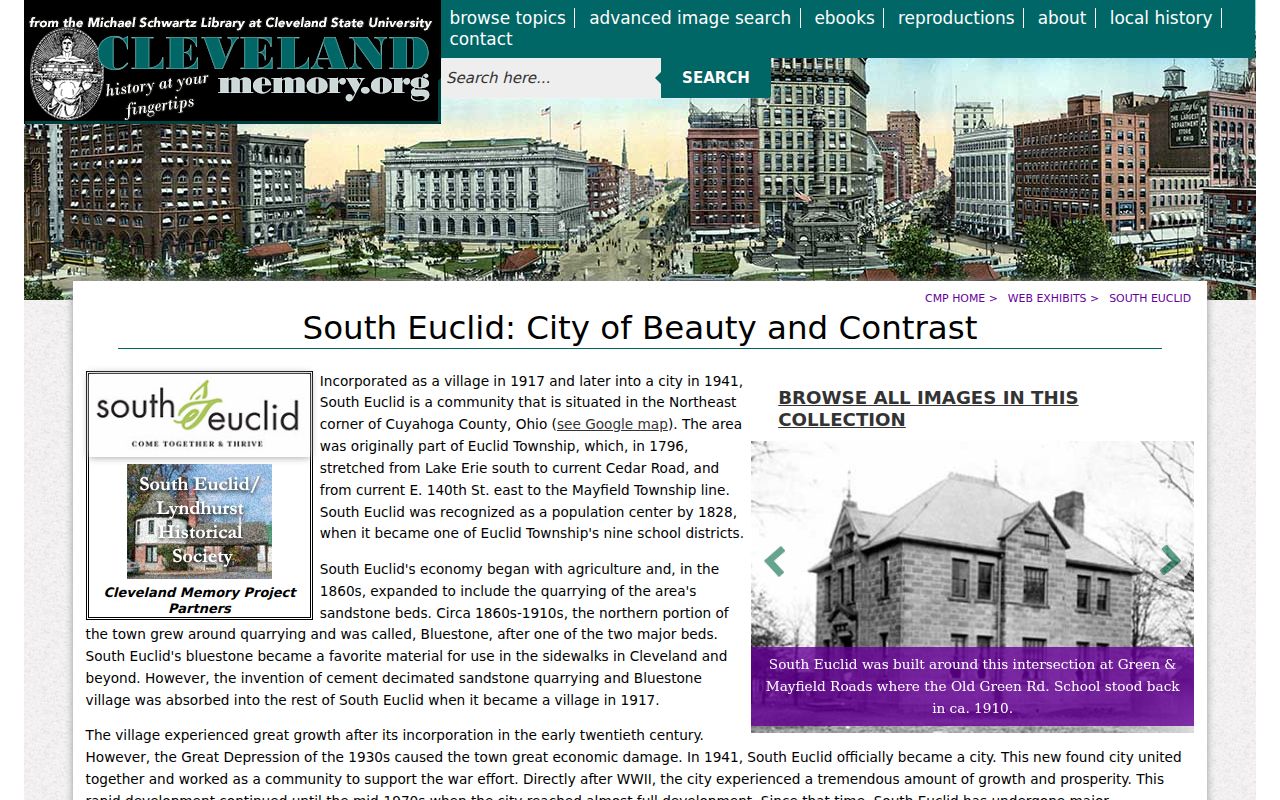
Its streetscapes and civic images help place a directory year in local history. They are not a personal-name directory. They cannot establish a person's identity.
Note: Preserve the address as written in its own year because street names, dimensions, and property descriptions can change.